When two tender documents disagree, the bidder pays
One tender package, two deadlines seven weeks apart. A one-word difference that changes your price for the whole contract. Contradictions found early become questions the buyer must answer; found late, they become guesses in your price. Here is how Atlas finds them on day one.
Pentimenti team
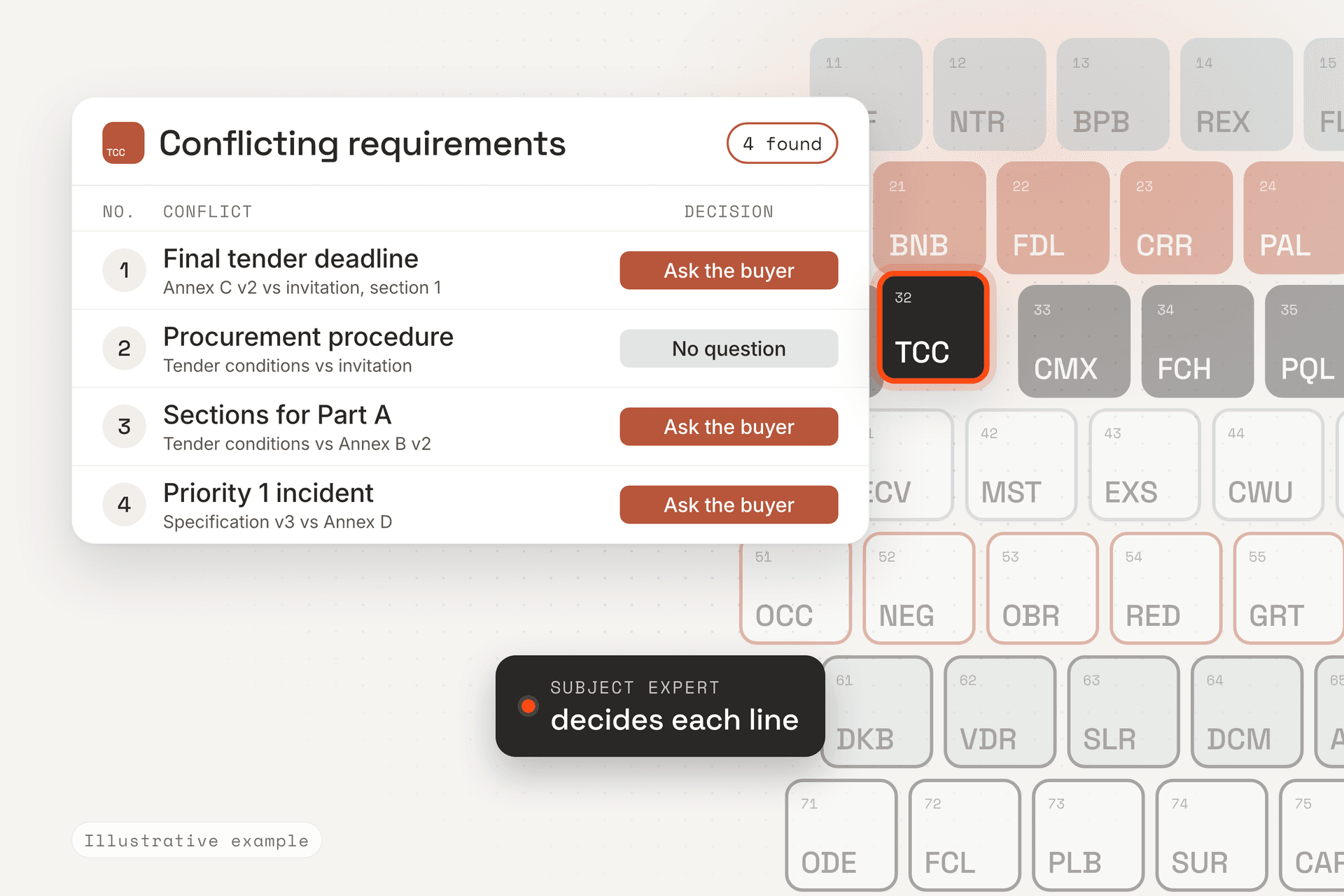
The timetable annex says tenders are due on 15 January 2027. The invitation to submit final tenders says 5 March 2027. Both files are in the current version of the package.
Plan for March when January holds, and there is no bid. Plan for January when March holds, and you give away seven weeks of writing time you had.
That one is easy to see once both files are open side by side. Most contradictions are quieter, and they cost more. In the same package, the requirements specification calls an incident priority 1 when it "stops" more than 100 users. The critical system list calls it priority 1 when it "affects" more than 100 users. One word. If "affects" holds, more incidents count as priority 1, the on-call cover has to be bigger, and your price has to carry that for as long as the contract runs. Price on the wrong word and you either give away margin or lose on price.
Tender packages are written by several people over several weeks, so they contradict themselves. The contradiction is not the problem. Finding it too late is. Found early, it is a question the buyer has to answer. Found late, it is a guess inside your price.
Here is what is at stake, and how Atlas finds contradictions on day one. The example is made up: the buyer, the bidder, the documents and every figure in them are synthetic.
Why nobody catches them
Nobody on a bid team reads every file against every other file. The bid manager reads the tender conditions and the invitation. The delivery lead reads the specification. The commercial owner reads the pricing schedule and the contract. A contradiction between two files that sit with two different people is the one that gets missed.
It surfaces later, when someone writes the service level section or prices the on-call cover. By then the window for asking has often closed.
The window is short, and it is in the law
The EU procurement directive gives bidders a right to answers, if they ask in time. "Provided that it has been requested in good time, the contracting authorities shall supply to all tenderers taking part in the procurement procedure additional information relating to the specifications and any supporting documents not later than six days before the time limit fixed for the receipt of tenders" (Directive 2014/24/EU, Article 53(2)). In an accelerated procedure, "that period shall be four days".
Ask in good time and the buyer must answer, or extend the time limit "where, for whatever reason, additional information, although requested by the economic operator in good time, is not supplied at the latest six days before the time limit fixed for the receipt of tenders" (Article 47(3)(a)). Ask late and that protection goes: the buyer need not extend when "the additional information has either not been requested in good time or its importance with a view to preparing responsive tenders is insignificant". Denmark, Sweden and Norway apply the directive through their national procurement acts. Check the tender conditions for the buyer's own question deadline as well.
So the value of a contradiction depends on the day you find it. In the first days after the package arrives, it becomes a question the buyer must answer in time. In the last week, it becomes an assumption you price and hope for.
Four contradictions in ten files
An IT services framework for a public agency, in its final tender round. The current version of the package has 10 files, from the tender conditions and the requirements specification to the pricing schedule, the timetable and the invitation to submit final tenders. Read against each other, they contradict themselves four times:
| No. | Topic | Source A | Source B | Decision |
|---|---|---|---|---|
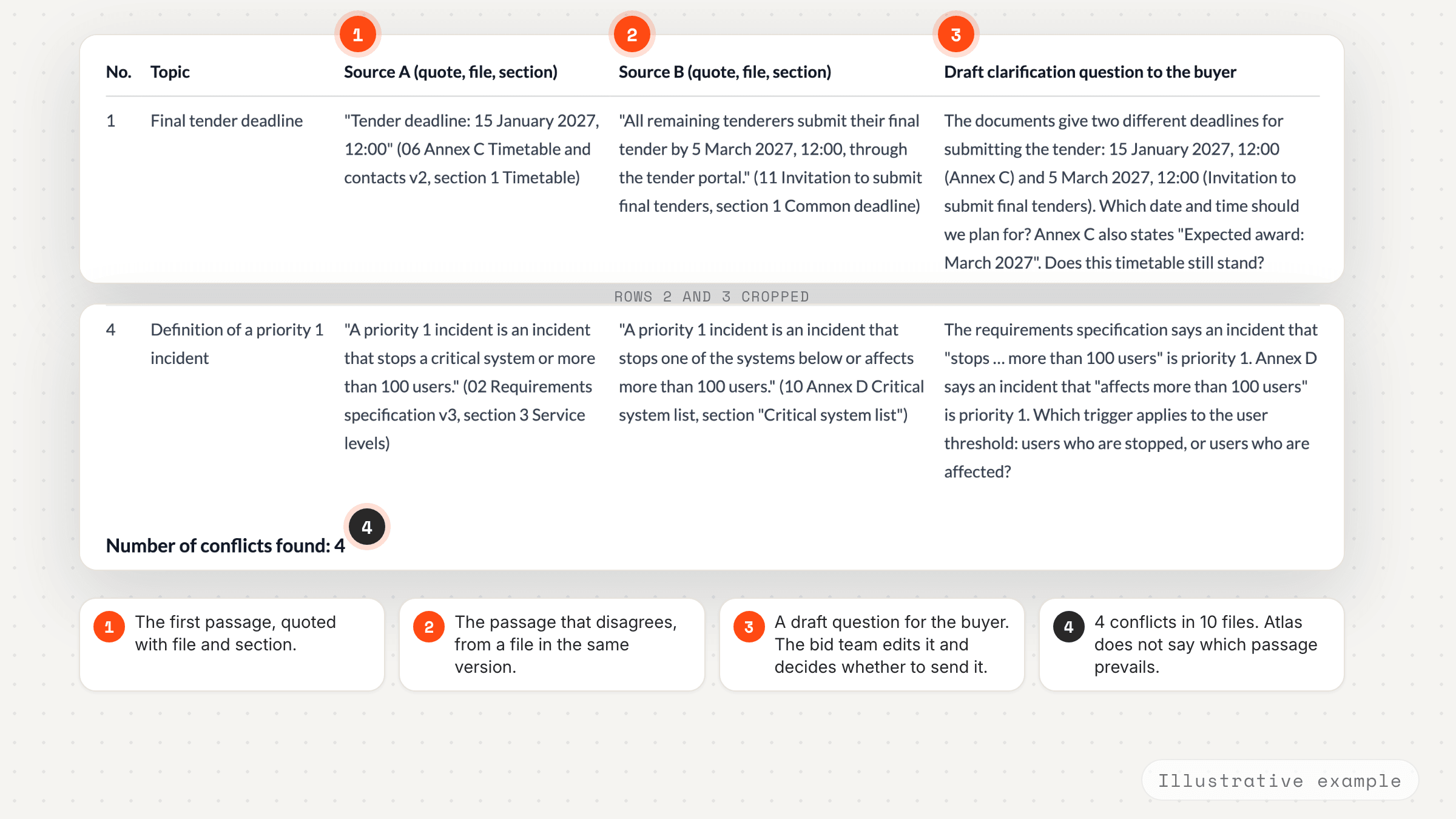
| 1 | Final tender deadline | "Tender deadline: 15 January 2027, 12:00" (Annex C Timetable v2, section 1, table row) | "All remaining tenderers submit their final tender by 5 March 2027, 12:00, through the tender portal." (Invitation to submit final tenders, section 1) | Ask the buyer. Bid manager |
| 2 | Procurement procedure | "The procedure is an open procedure under the national procurement act" (Tender conditions, section 1) | "The procedure is a competitive procedure with negotiation under the national procurement act" (Invitation to submit final tenders) | No question. Bid manager records that the invitation sets the procedure for this round |
| 3 | Sections answered in Part A | "Service delivery (solution description, section 3 to 5 of document 02)" (Tender conditions, section 3) | "Solution description, answering section 2 to 4 of the requirements specification" (Annex B Submission format v2, section 1) | Ask the buyer. Delivery lead |
| 4 | Priority 1 incident | "A priority 1 incident is an incident that stops a critical system or more than 100 users." (Requirements specification v3, section 3) | "A priority 1 incident is an incident that stops one of the systems below or affects more than 100 users." (Annex D Critical system list) | Ask the buyer. Commercial owner |
Three of the four change what the bid team does:
- Line 1 decides whether there is a bid. The wrong date either kills the submission or wastes seven weeks.
- Line 3 decides the score. The tender conditions point to sections 3 to 5 of the specification, the submission format to sections 2 to 4, and version 3 of the specification has only sections 1 to 4. Answer the wrong sections and the evaluators look for answers that are not where they expect them.
- Line 4 decides the price. "Affects" is a wider trigger than "stops", so the same contract needs more priority 1 cover.
Line 2 needs no question. The tender conditions still describe the open procedure the tender started as, and the invitation describes the round the bid team is in. The bid manager records that on the line, so nobody raises it again in week three.
What Atlas does
Atlas reads the selected files against each other and returns the contradictions as one list. Saved to the library and selected when a proposal is created, the check runs on every new tender, and the list arrives with the rest of the initial processing, on day one. Each line quotes both passages with file and section, names the topic, and carries a draft question for the buyer. In our demo, Atlas found the four contradictions above in the 10 files, and the list was back in under five minutes.
The quotes matter more than they look. A paraphrase invites "are you sure it says that?", and the subject expert has to open both files to check. A quote with file and section answers that on the line, so the expert decides from the list, not from the whole package.
This comes from customer use. At one customer's onboarding in February 2026, a user named a summary for contradictory requirements, set up in the session as a custom summary in table format, and asked how to export it for the rest of the team. The same month, a team trialling Atlas on one of its own tenders told us that when they asked Atlas for clarification questions, it caught contradictions a colleague had spent a long time working out.
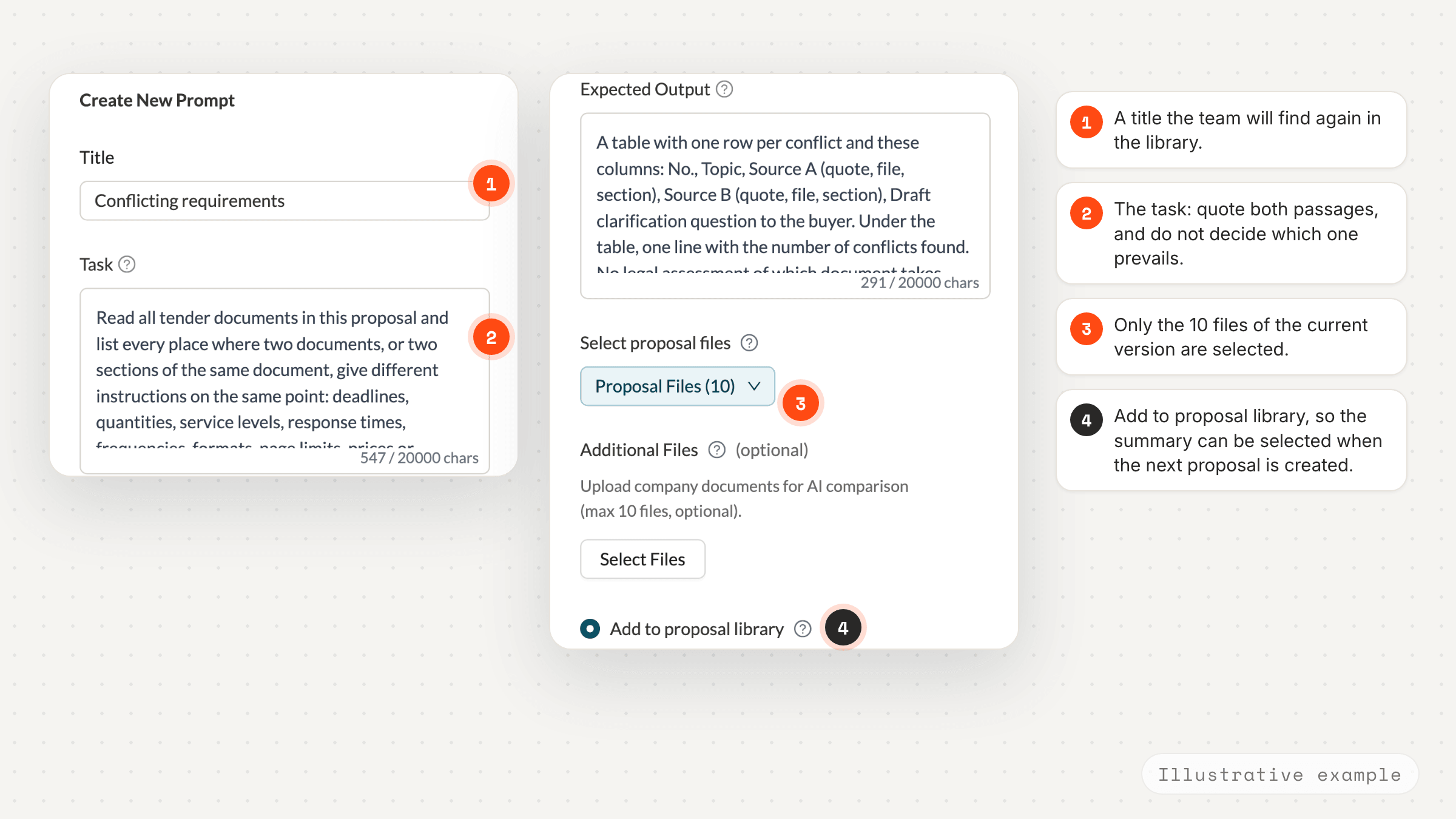
Set it up once. The check is a custom stakeholder summary. In Bid Assessment, under Stakeholder Summary, New Summary opens a drawer (titled Create New Prompt) with a title, a task and an expected output. The task tells Atlas what counts as a contradiction and that it must quote both passages and not decide which one prevails. The expected output asks for a table with the topic, both quotes with file and section, and a draft question for the buyer. The bid team adds the decision. Select proposal files limits the check to the files of the current version.
Run it on every tender. Tick Add to proposal library when you create the summary. Summaries in the library can be selected when the next proposal is created, and Atlas then generates them during the initial processing of the tender.
What the bid team does with the list
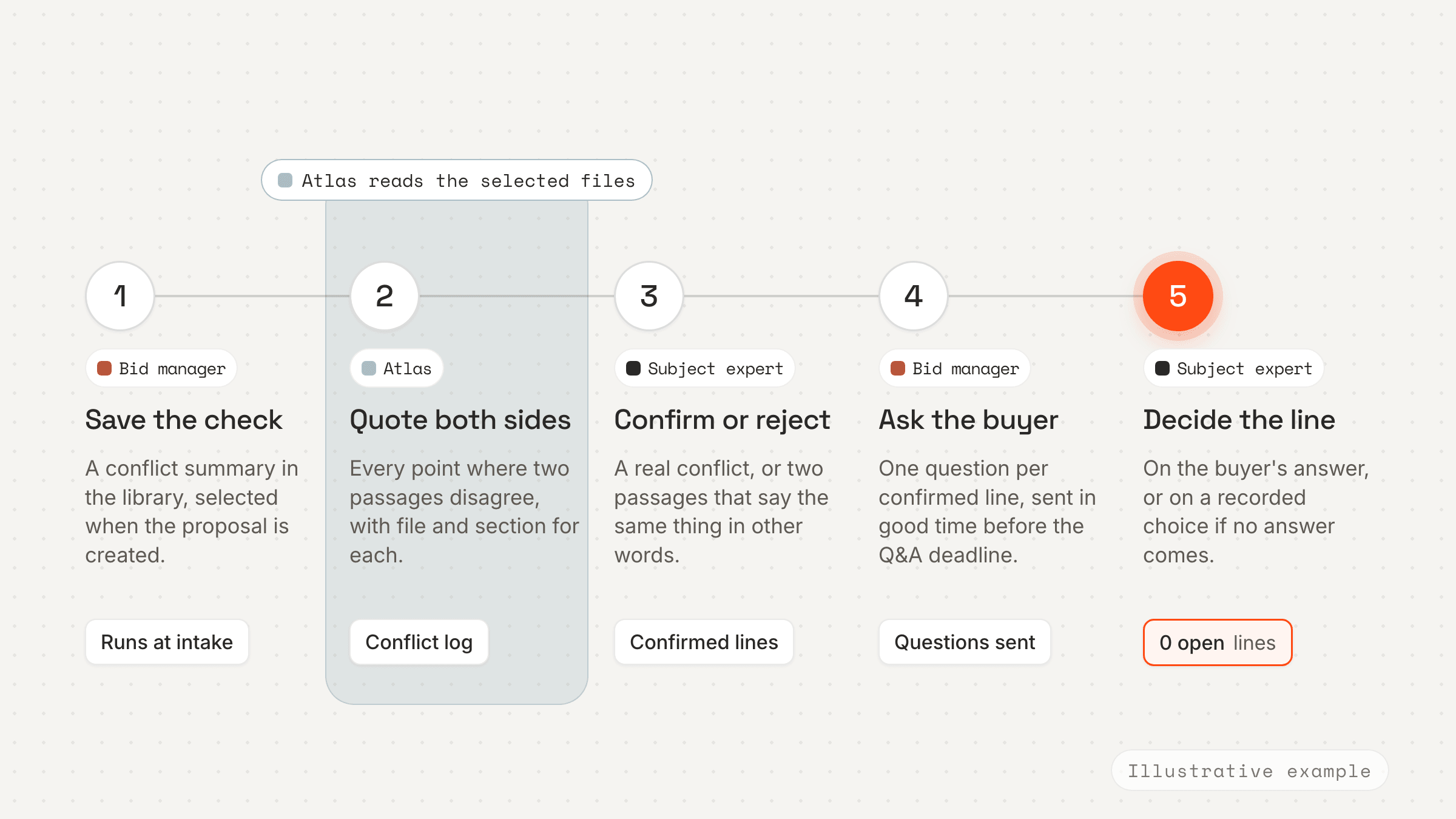
- Route each line to the person who owns the topic. The delivery lead takes the specification, the commercial owner the pricing and contract, the bid manager the process.
- Confirm or reject each line. Two passages can say the same thing in different words. The subject expert rejects that line and keeps the reason.
- Send the questions early. Through the buyer's Q&A channel, one question per confirmed line, in good time before the question deadline.
- Decide every line. On the buyer's answer, or, if no answer comes, on a choice the subject expert records with a name and a date. No line goes into the final tender undecided.
Run the check on the current version only. Older versions contradict newer ones by design. That is a change between versions, which we covered in reissued tender packages.
What Atlas does not do
It does not decide. Atlas quotes both passages and drafts a question, and the subject expert decides each line. It does not rule on which document takes legal precedence, and it is not legal advice. It does not send questions to the buyer. And it does not promise to find every contradiction. It reads only the files selected for the summary, so a contradiction in a file left out stays with the people reading the package.
If you already use Atlas
Three checks for teams that already run bid assessment in Atlas:
- Is a conflict summary in your proposal library, and is it selected when you create a proposal?
- When the buyer publishes answers, have you committed them as a new version and regenerated the conflict summary? Stakeholder summaries do not update on their own when a new version is committed.
- Does every line have a decision and a name before the final tender goes out?
Where this sits
The tender consistency check is element 32 (TCC) in our periodic table of commercial work, in the Comply family: tender documents that contradict each other go in, Atlas quotes both instructions side by side and drafts a question for the buyer, and a subject expert decides. It is a record for the subject review, not a legal ruling.
Its neighbours are the amendment impact list (AIL, 31) for changes between versions and the compliance matrix (CMX, 33), which checks that every requirement has an answer before submission. Once the bid is won, the same discipline applies to the contract, as in from won bid to signed contract. For how Atlas reads the tender in the first place, see tender assessment with Pentimenti.
What the check buys is time. A contradiction found in the first week goes to the buyer as a question, and the answer comes back while there is still time to write and price against it. Found in the last week, it goes into your price as a guess.