Before the final offer: a deviation log for the negotiation review
In a negotiated procedure the risk sits in the final offer. One log, kept from the initial offer to the final one: every reservation gets a status, an approver and a signature before the common deadline.
Pentimenti team
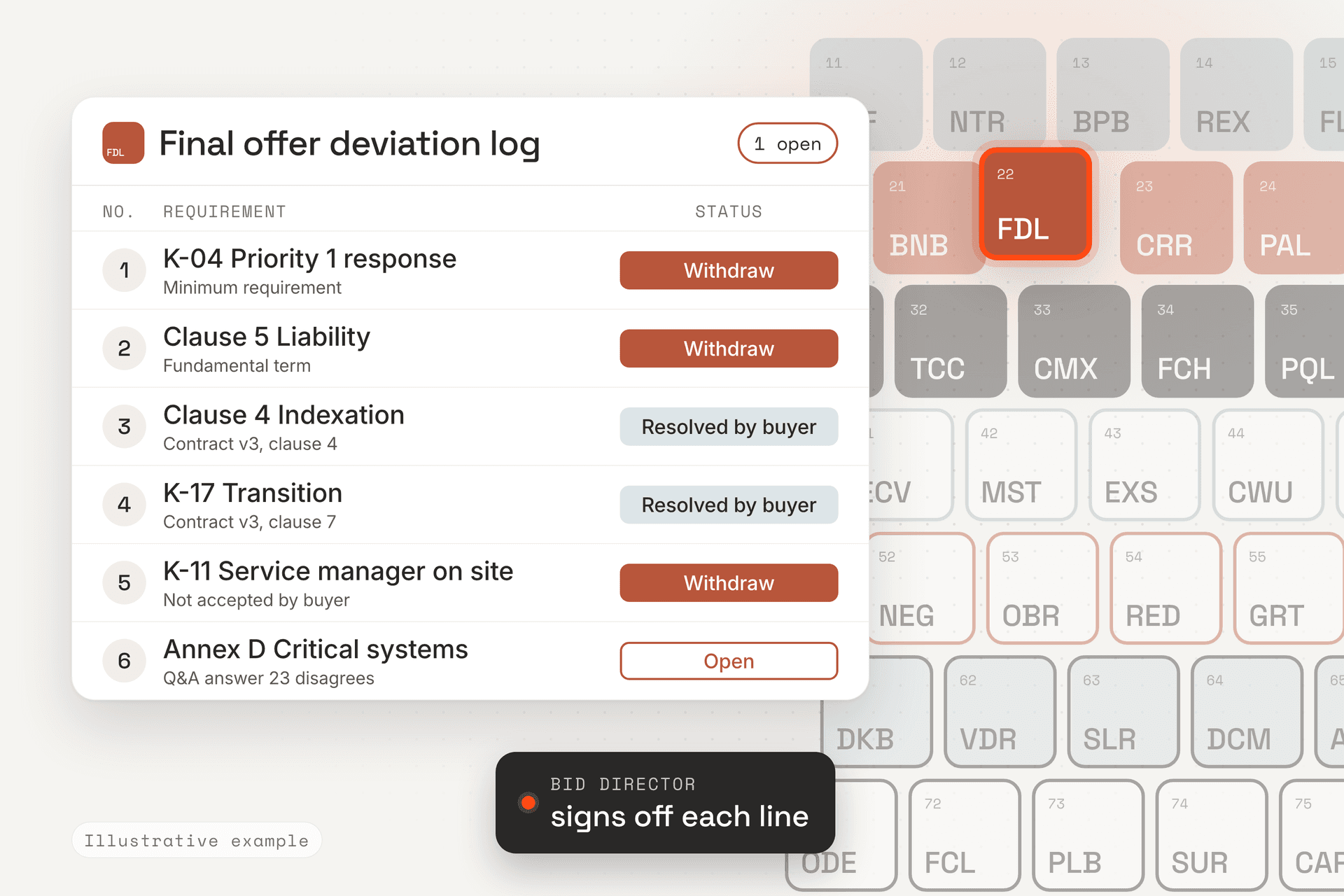
In a negotiated procedure everyone expects the first offer to change. The risk sits in the final one. A reservation you agreed to drop is still in an annex. A point the buyer accepted in the meeting never reached your price assumptions. A minimum requirement you hedged in round one is still hedged.
A BAFO deviation log stops that. It is one list, kept from the initial offer to the final one, with a line for every reservation, deviation, assumption and open question you put forward. Each line shows what the current documents say, what happens to it, and who may approve that. Before the final offer goes out, every line is closed and signed off.
Here is the method, a worked example, and the part Atlas takes on. The example is made up. The buyer, the bidder, the documents and every figure in it are synthetic.
The rule behind it
Under the EU procurement directive, the buyer in a competitive procedure with negotiation must say "which elements of the description define the minimum requirements to be met by all tenders" (Directive 2014/24/EU, Article 29(1)). The buyer negotiates the initial and later tenders "except for the final tenders", and "the minimum requirements and the award criteria shall not be subject to negotiations" (Article 29(3)). The buyer may also skip negotiation and award on the initial tenders, if it reserved that right in the contract notice (Article 29(4)).
When the negotiations end, the buyer sets "a common deadline to submit any new or revised tenders" and checks that the final tenders "are in conformity with the minimum requirements" (Article 29(7)). Denmark, Sweden and Norway apply the same directive through their national procurement acts.
So when there is a negotiation round, it is the last chance to settle a reservation. Whatever is still open at the deadline goes into the final offer as it stands.
The setup: one framework, six open points
An IT services framework for a public agency, run as a competitive procedure with negotiation. The bid team's initial tender carried six points: three reservations, one deviation, one assumption and one open clarification.
After the negotiation meeting the buyer sends the minutes, a revised requirements specification, a revised draft contract, a new annex and an invitation to submit final tenders. The common deadline is three weeks away.
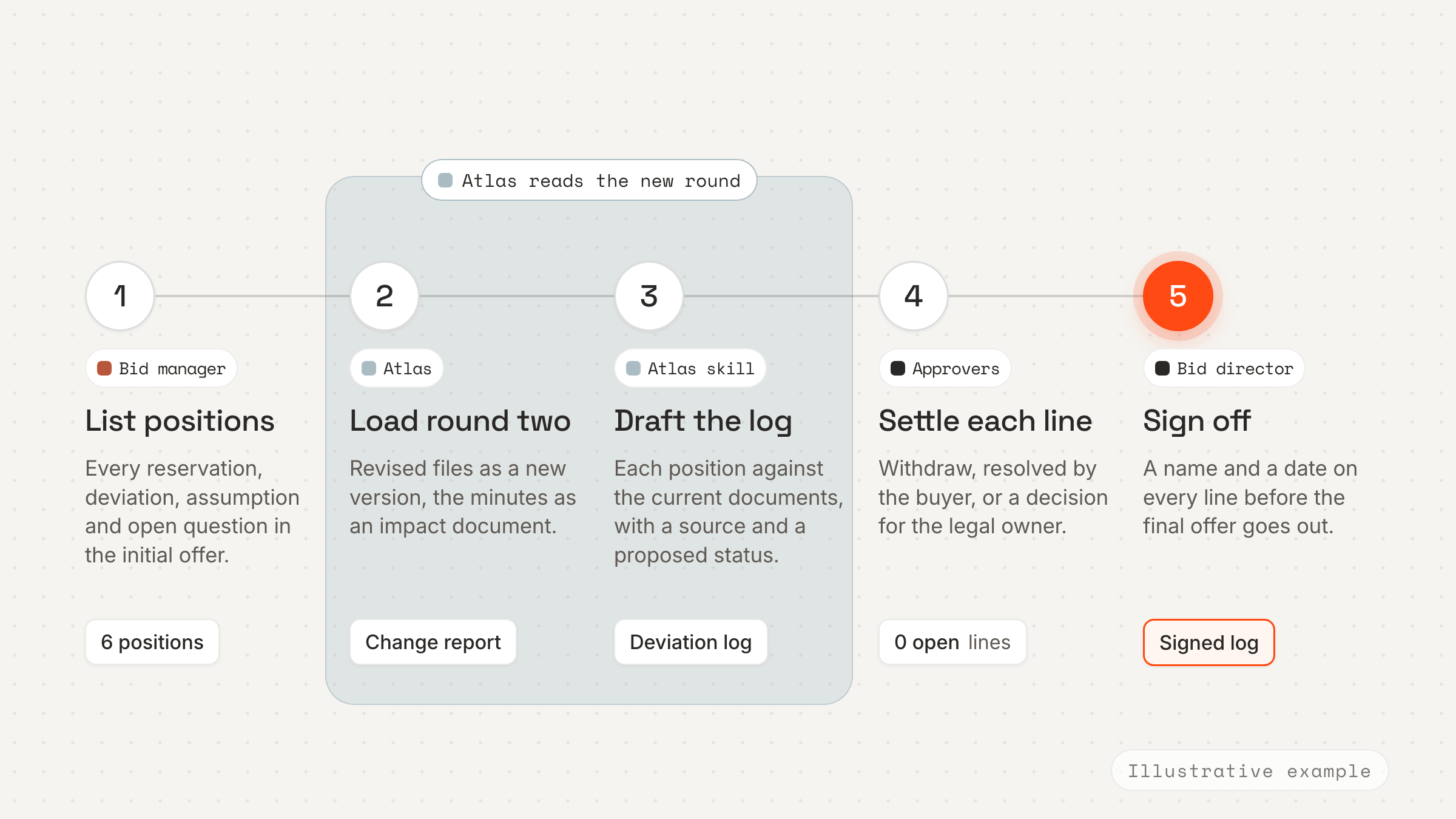
Step 1: list every position you took in the initial offer
Start from your own initial tender, not from the buyer's new package. Pull out everything that departs from the tender or depends on something outside your control:
- Reservations: you meet the requirement only on your terms.
- Deviations: you offer something other than what was asked.
- Assumptions: your price or plan depends on a condition.
- Open clarifications: you asked the buyer and are waiting for the answer.
Give each one its source: the requirement ID or clause and the document version it came from. This list is the backbone of the log, so the bid manager owns it.
Step 2: load the new round and read what changed
Read the buyer's round-two package against the version you bid on. We covered how in reissued tender packages: load it as a new version and start from the change report. In a negotiation round, two documents need extra care. The minutes record what the buyer said about your points. The invitation to submit final tenders states the common deadline and which requirements are minimum requirements.
Step 3: give every line a status and an approver
Match each point to what the current documents say, and give it one of four statuses:
- Withdraw: the point conflicts with a minimum requirement, or the buyer has refused it.
- Resolved by buyer: the revised documents now cover the point, so the reservation can go.
- Keep: the point stays in the final offer. Never for anything that touches a minimum requirement.
- Open: a person has to make a commercial or legal call first.
Each line also names who may approve it. In the example the log looks like this:
| No. | Requirement and source | Our position in the initial offer | What the current documents say | Status | Approved by |
|---|---|---|---|---|---|
| 1 | K-04, requirements specification v3 | Priority 1 response in 2 hours in service hours only | Minimum requirement. 2 hours at any time, not negotiated | Withdraw | Bid director |
| 2 | Clause 5, draft contract v3 | Liability capped at 100% of the annual value | Clause 5 unchanged at 150%. A reservation leads to rejection | Withdraw | Legal owner |
| 3 | Clause 4, draft contract v3 | Prices indexed after 12 months, not 24 | Accepted. Clause 4 now indexes after 12 months | Resolved by buyer | Commercial owner |
| 4 | K-17, requirements specification v3 | 4-month transition assumes handover within 2 weeks | Clause 7 now requires handover within 10 working days | Resolved by buyer | Delivery lead |
| 5 | K-11, requirements specification v3 | Service manager on site 1 day a week | Not accepted. At least 2 days a week | Withdraw | Delivery lead |
| 6 | Q&A answers 22 and 23, Annex D | Price on-call cover once we see the critical system list | Minutes: list published as Annex D. Q&A answer 23 still says it goes to the winner only | Open | Legal owner |
Three lines are withdrawn, two are resolved by the buyer's changes, and one is open.
Step 4: settle the open lines and update the offer
Each status has a job attached. A withdrawn line changes the offer: line 1 means pricing round-the-clock cover for priority 1 incidents, line 5 means a second day on site in the staffing plan. Line 2 is the hard one. Withdrawing the liability reservation means accepting clause 5 as written, so the legal owner decides whether the company can carry it or submits no final tender.
A line resolved by the buyer means removing the reservation and updating whatever depended on it: line 3 changes the price assumptions, line 4 the transition plan.
The open line is a conflict between documents. The minutes say the critical system list is published, and an older Q&A answer says it goes to the winner only. The legal owner decides which stands, and the commercial owner prices the on-call cover on that basis. The log cannot answer either question. It makes sure both are asked before the deadline, not after the award.
Step 5: the bid director signs off each line
Before submission, the bid director signs off each line, with a name and a date. No line goes into the final offer with the status Open.
Keep the signed log. If you win, the contract check in from won bid to signed contract starts from the final offer, and the log shows exactly what changed in it.
What Atlas does
Parts of this method are in live use. A customer user who loaded the new tender files for a BAFO round told us in June 2026 that uploading them and seeing what had changed "worked very well". In October 2026, another customer ran a tender deviation analysis skill on three days in a row, next to a final-offer improvement plan. A third worked a BAFO-stage bid with a prioritised list of action points in a spreadsheet.
In Atlas, the steps map like this.
The new round goes in as a version. The bid team keeps working in the proposal they wrote the initial offer in. In Documents, they replace the revised files, add the new ones and commit the round as a new version, and Atlas writes a change report against the previous one.
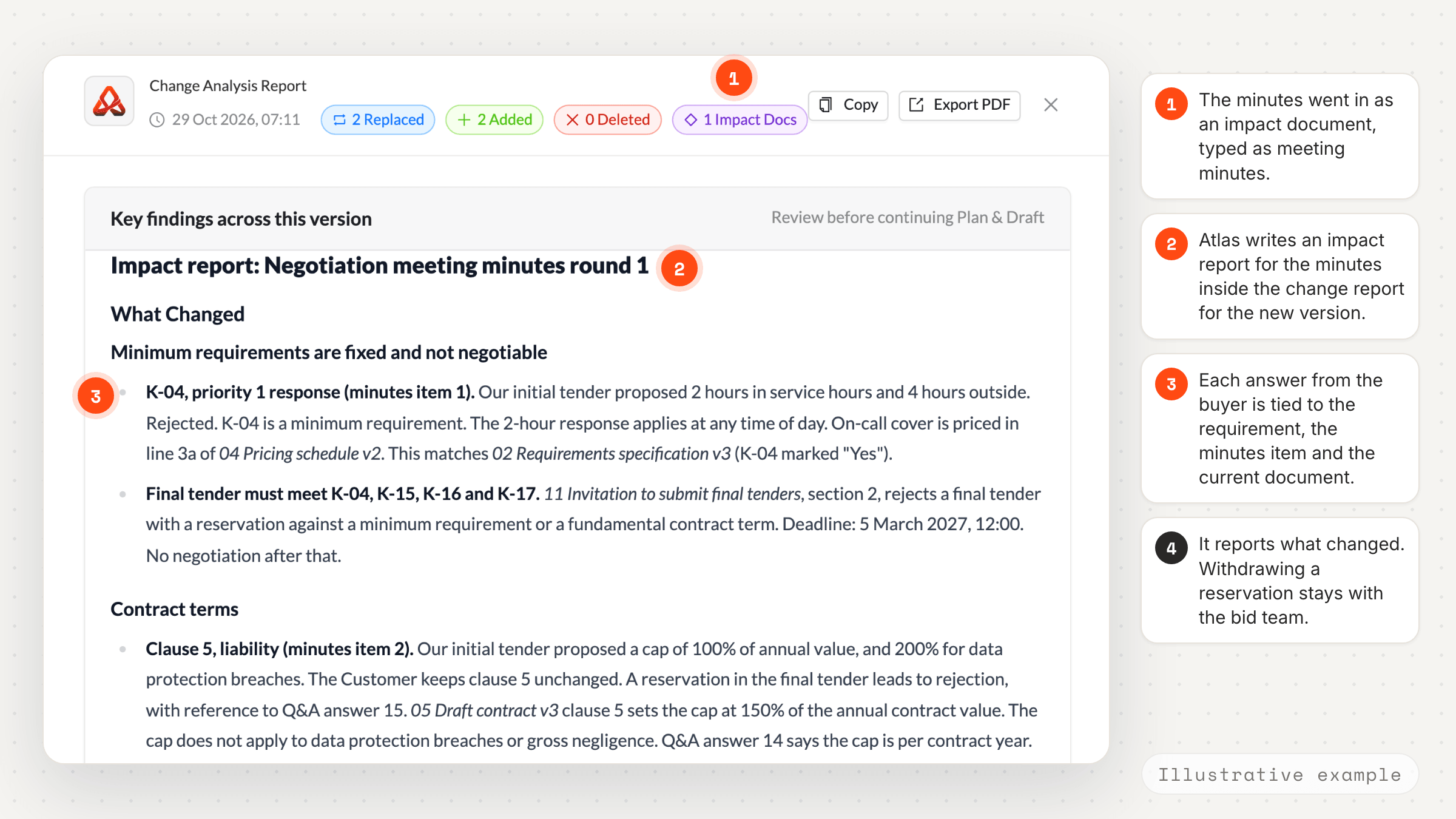
The minutes go in as an impact document. An impact document is a file that changes the scope or terms of the tender without being part of the package, such as minutes or a Q&A log. Atlas asks what type it is (clarifying Q&A, meeting minutes, amendment summary, feedback on submission, or other) and writes an impact report for it inside the change report. Each of the buyer's answers is tied to the requirement, the minutes item and the current document.
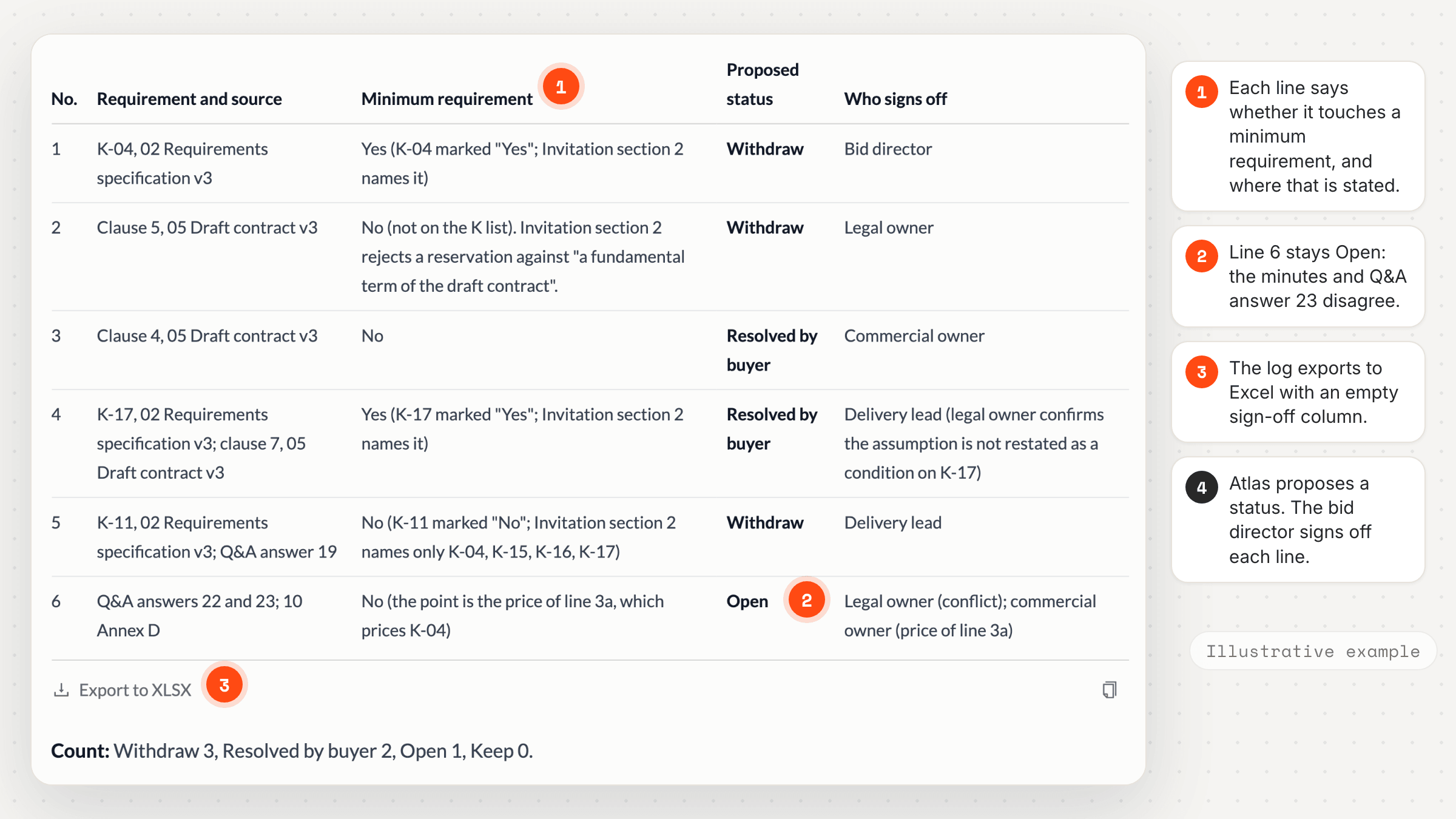
A skill drafts the log. A skill is a set of written instructions, saved in the Atlas library, that the team calls in chat. A deviation log skill tells Atlas which columns to fill, which four statuses to use, and when a line must stay Open. The team shares it once, and every bid manager runs it the same way. In the proposal chat, the bid manager attaches the list from step 1 and calls the skill. Atlas reads the current version and the minutes, fills the log with the source for each line, and exports it to Excel with an empty column for the sign-off. In our demo it also flagged one point outside the six: the timetable annex still showed the old tender deadline.
What Atlas does not do
It does not decide. The skill proposes a status, and a person approves it. It does not set prices or negotiate with the buyer. It does not judge which document prevails when two disagree. In the demo, when the minutes and an older Q&A answer disagreed, the skill left the line Open for the legal owner. And it only knows what was said in the meeting if the minutes are uploaded.
If you wrote the initial offer in Atlas
Keep the same proposal for the negotiation round. Four checks before the common deadline:
- Is the buyer's round-two package committed as a new version, with the minutes added as an impact document?
- Does every point from your initial offer have a line in the log?
- Is any line that touches a minimum requirement still marked Keep?
- Has the bid director signed off every line, with no line left Open?
Where this sits
The final offer deviation log is element 22 (FDL) in our periodic table of commercial work, in the Decide family. What goes in: the buyer's requirements, your proposed exceptions and unanswered questions. What Atlas does: record each exception to the requirements in the final offer and who may approve it. What comes out: a list of exceptions and decisions to resolve before the final offer. Who decides: the bid director signs off each exception.
Its neighbours: the bid or no-bid decision (BNB, 21) comes before the first offer, and the amendment impact list (AIL, 31) handles a revised package, as in reissued tender packages. For how Atlas reads the tender in the first place, see tender assessment with Pentimenti.