What Is Agentic AI Bid Management? A Guide for Bid and Proposal Teams
Agentic AI bid management uses AI agents to read a tender, map its requirements, draft from your own content and check compliance - not one prompt at a time. What it means, and where it doesn't help.
Pentimenti
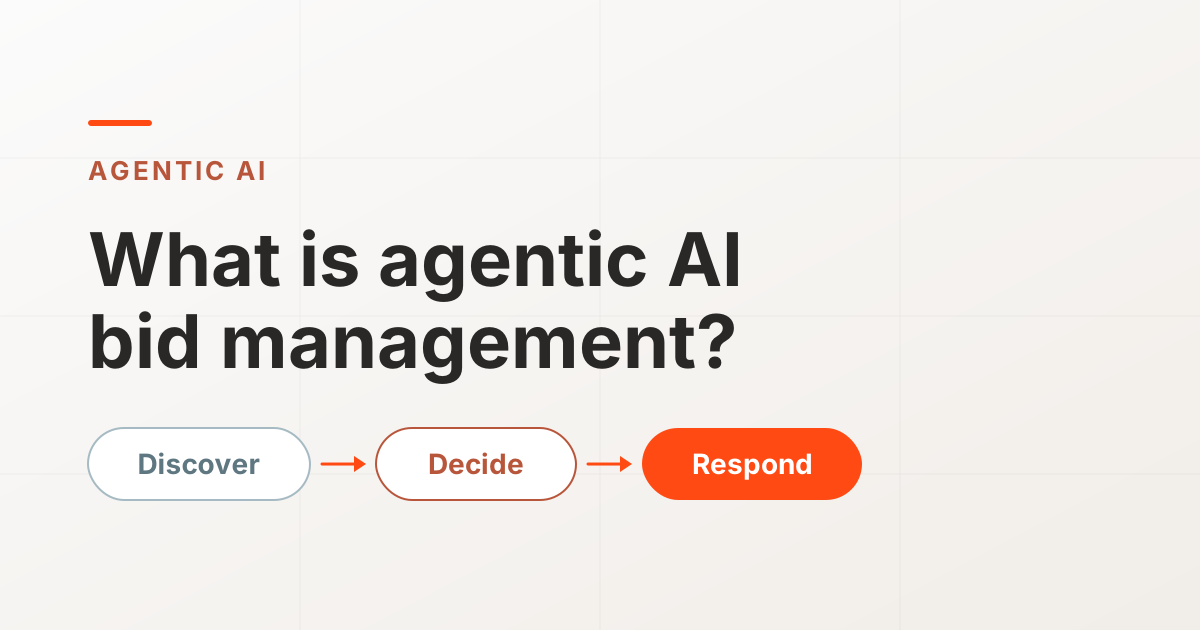
What is agentic AI bid management?
Agentic AI bid management is the use of AI agents that carry out multi-step bid work on their own (reading a tender, mapping its requirements, drafting answers from your existing content, and checking compliance) instead of answering one prompt at a time. The difference from a chatbot is autonomy and scope: an agent is given a goal and the tools to reach it, and works through the steps, showing its sources as it goes.
That distinction matters commercially, not just technically. A generic assistant makes your bid writer faster at typing. An agentic system changes what the bid writer does at all - from producing first drafts to reviewing and improving them.
What makes a system "agentic" rather than just "AI"
Three properties, and a tool needs all three to earn the label:
1. It works in multiple steps toward a goal. Given "respond to this tender", it breaks the work down (extract requirements, find relevant material, draft each section, check coverage) rather than returning one block of text and stopping.
2. It uses tools and acts on real material. It opens the actual tender document, searches your past bids and policies, and writes into the response structure. A chat window that only knows what you pasted into it isn't doing this.
3. It is grounded in your own content, and shows where each answer came from. This is the part buyers underrate. An answer you can trace to a source document is one a reviewer can verify in seconds; an answer with no provenance has to be re-researched from scratch, which is often slower than writing it yourself.
Miss any of the three and you have something useful but different: a writing assistant, a search tool, or a document repository.
The three jobs in a bid lifecycle
Bid work splits into three distinct problems, and they need different things from AI:
- Discover - finding the tenders worth seeing at all. Mostly a coverage-and-filtering problem: are you seeing every relevant opportunity across the portals that matter to you, without drowning in irrelevant ones? See AI tender discovery.
- Decide - the bid/no-bid call. The most valuable and most neglected step: the cheapest way to improve win rate is to stop writing bids you were never going to win. This needs the tender read against your real capability and past performance. See bid/no-bid decision software.
- Respond - producing a compliant, persuasive answer. Where most tools focus, and where drafting from your own approved content matters most. See AI proposal and RFP response software.
Tools that only do the third leave the two decisions that most affect win rate untouched.
What the agents actually are
"Agent" gets used loosely, so here is the concrete version. Rather than one generalist model, the work is split across specialised agents, each grounded in a different part of your material:
- a compliance agent that maps the tender's requirements and tracks whether each one is answered;
- a knowledge agent working from your product documentation, policies, and past bids;
- product agents trained on specific vendor documentation so technical sections carry the right detail;
- a CV agent for team and personnel sections, drawing on real CVs;
- a reference agent for past-project and case-study evidence;
- a contract agent that reads the contract framework and flags where terms deviate from your standard positions - liability, IP, data protection, indemnity, termination.
The practical effect: your subject-matter experts review the expert sections instead of writing them. For most organisations, the bottleneck was never drafting - it was waiting on busy specialists.
Agentic AI vs a generic assistant vs a content library
Three genuinely different tools, each good at something:
| Generic AI assistant | Content-library RFP tool | Agentic AI bid management | |
|---|---|---|---|
| Reads the actual tender | Only what you paste in | No | Yes - ingests the full document |
| Source of content | Starts blank each time | A library your team builds and maintains | Your existing documents, learned continuously |
| Requirement-by-requirement compliance | No | Partial, manual | Automatic compliance matrix |
| Source attribution | None | Limited | Every answer traced to its source |
| Confidential tender data | Leaves your control on consumer tools | Contained | Stays in your environment |
| Finds new tenders | No | No | Yes |
| Setup and upkeep | None, but no leverage | Weeks to build, then ongoing curation | Works from what you already have |
| Best for | Quick ad-hoc drafting | Storing a governed Q&A bank | Running complex tenders end to end |
The genuine case for each. A generic assistant is free or nearly free and excellent for unblocking a paragraph - just never paste confidential tender material into a consumer tool. A content library is the right answer if what you actually want is one governed repository that a librarian curates; some regulated organisations need exactly that, and auditors sometimes ask for it. Agentic tooling is the right answer when your constraint is your writers' time and your library keeps going stale.
Why "closed system" keeps coming up
A recurring question in European tenders: if we put our bid material into an AI tool, where does it go? Tender responses contain pricing strategy, staffing, partner arrangements, and sometimes security architecture - the things you least want in someone else's training data.
Two things to get in writing from any vendor:
- Is our data used to train your models? It should be contractually excluded, under an Article 28 data processing agreement.
- Which region does our data sit in? GDPR compliance and EU data residency are not the same thing - a vendor can be fully GDPR compliant while storing your data outside the EU under transfer safeguards. If EU-only storage is a requirement, it has to be stated, not assumed.
For reference, our own deployment options are published rather than quoted: a standard tier on global enterprise cloud, an EU Sovereign tier where data stays in the EU and runs on European models, and a single-tenant dedicated EU instance for the most confidential work. Your data is never used to train models on any tier. We do not think this makes us the only credible choice - but you should be able to get a straight answer to both questions from whoever you buy from. We go through how to ask them in comparing Loopio alternatives as an EU team.
Where agentic AI does not help
Anyone selling this without the caveats is selling badly.
- It does not remove the reviewer. A named human still has to be accountable for what you submit. The gain is that reviewing a sourced draft is far faster than writing from nothing - not that review disappears.
- It cannot invent past performance you don't have. If you have no comparable project, no tool will conjure credible evidence. It will help you present what you do have accurately.
- Output quality tracks your source material. Organisations with well-kept past bids and policies get much more from this than organisations whose knowledge lives in individuals' heads. If your material is thin, expect a slower start.
- It will not fix bidding for the wrong work. This is why the bid/no-bid step matters more than drafting speed. Writing losing bids faster is not progress.
- Compliance checking is a safety net, not a guarantee. An automatic requirement matrix catches omissions reliably; it does not replace a final read against the tender documents.
Frequently asked questions
What is AI bid management? Using AI to support the bid lifecycle - finding tenders, deciding which to pursue, and producing responses. "Agentic" AI bid management is the subset where the AI executes multi-step work with tools and provenance, rather than generating text one prompt at a time.
What is the difference between agentic AI and using ChatGPT for bids? Scope, grounding, and confidentiality. A general assistant only knows what you paste in, starts blank each time, and offers no requirement tracking or source attribution - and pasting tender material into a consumer tool puts confidential content outside your control. An agentic system reads the full tender, works from your approved content, and cites its sources.
Can AI write tender responses reliably? It can produce a strong, compliant first draft when grounded in your own material, with each answer traceable to a source. It cannot be left unsupervised: a human owner should still review and approve before submission. Treat it as removing the blank page, not the judgement.
How does AI improve the bidding process? Three ways, in rough order of value: better bid/no-bid decisions, so you spend effort on winnable work; faster first drafts, so specialists review rather than write; and more reliable compliance coverage, so you stop losing on technicalities.
Is my data private with AI bid tools? It depends entirely on the vendor and the contract. Ask two questions - is our data used for model training, and which region is it stored in - and get both answered in the agreement rather than in marketing copy.
Is agentic AI bid management only for large enterprises? No. Smaller teams often get more from it per person, because they face the same tender complexity with a fraction of the bid staff - the same reason they hire bid consultants for individual tenders.
How is this different from hiring a bid-writing consultant? It is closer to a consultant than to a software platform: the work of reading the tender, mapping requirements and drafting gets done for you, rather than handed to you as a tool to operate. The differences are availability and retention - an agentic service handles the week two tenders land rather than one, and what it learns about how your organisation bids stays with your organisation when the engagement ends.
See it on your own tender
The honest test of any of this is a document you already know. Bring a live tender to a walkthrough and watch the requirement matrix and source attribution build against your own material - or see the platform for how Discover, Decide, and Respond fit together.