Why We Built Pentimenti as an AI Colleague, Not an AI Tool
Pentimenti was built on a single architectural bet: bid management doesn't need a smarter search bar. It needs a colleague. Here's why we built Atlas as an agentic AI system, and why that distinction changes everything.
Siddhartha Singh
CTO of Pentimenti.ai · LinkedIn
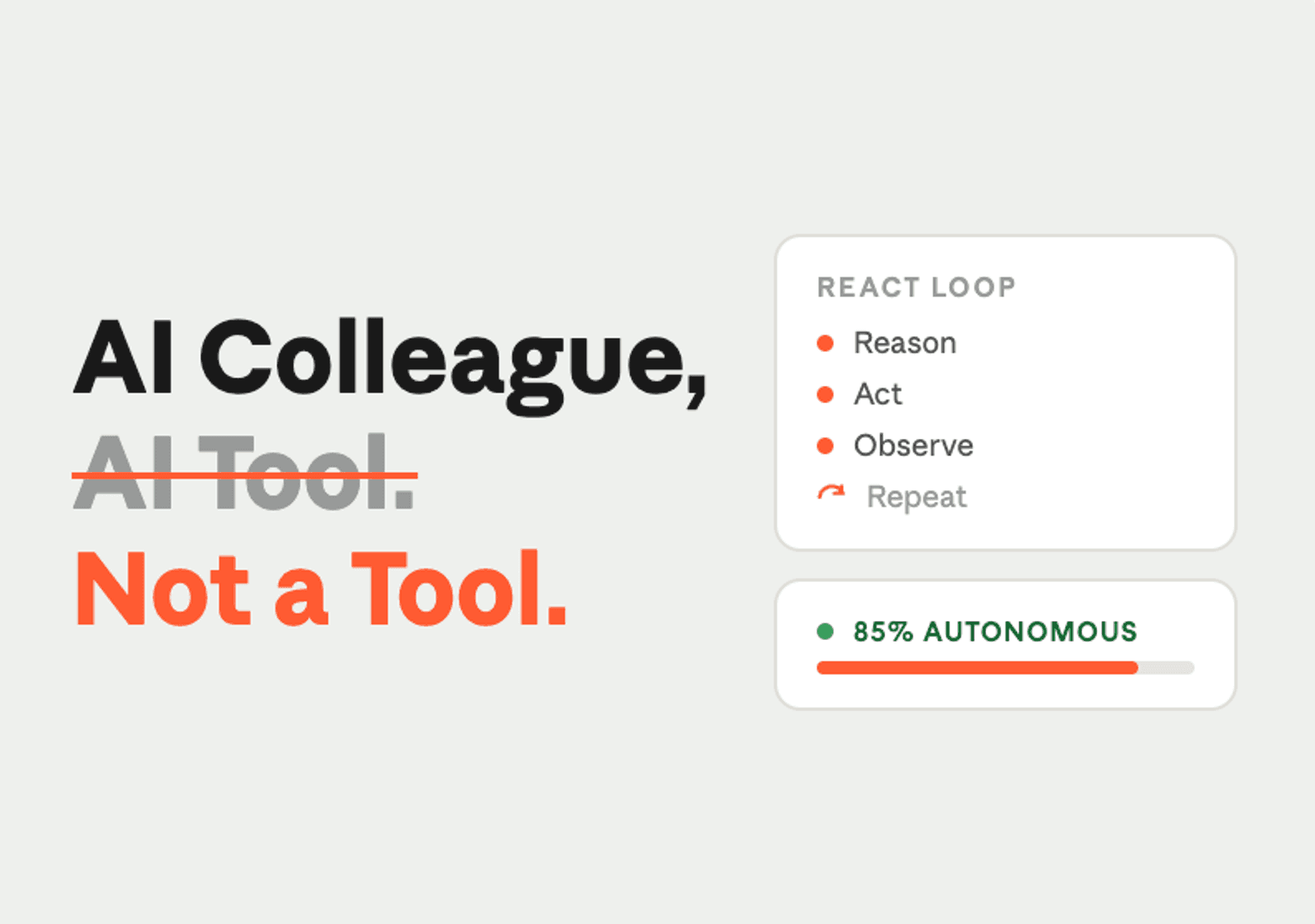
At GTC 2026, Nvidia CEO Jensen Huang predicted that every SaaS company will become an Agentic-as-a-Service company. Software that does the work, not software that helps you do the work.
When we heard that, we did not celebrate a new trend. We recognised a description of what we had already built six months earlier.
Pentimenti was founded on a single architectural bet: bid management does not need a smarter search bar. It needs a colleague. That colleague is Atlas, our AI agent.
The Problem with "AI-Powered" Bid Tools
Most proposal and RFP platforms, whether built in 2014 or retrofitted in 2024, force bid teams to choose between two fundamentally limited paradigms.
Option 1: The Content Library. Traditional proposal software stores your past answers and case studies. When a new tender arrives, you search the library, retrieve fragments, and assemble a response. Some add a generative AI layer on top, so you paste a question and get a drafted snippet. The AI retrieves information. You still do all the orchestration.
Option 2: The Generic LLM. Tools like ChatGPT or Claude are powerful reasoning engines, but they have zero memory of your company, your past tenders, or how you work. Every session starts from scratch. You paste context, engineer prompts, and manage the back-and-forth. And the moment you push beyond a handful of documents, 10 files, 20 files, the outputs degrade. Hallucinations increase. Coherence breaks down. A tool that looks impressive on one document becomes a liability on a real enterprise tender.
Neither of these architectures solves the actual problem.
A tender is not a question-and-answer exercise. It is a complex, multi-document, multi-stakeholder project that requires understanding hundreds of requirements simultaneously, maintaining consistency across dozens of response sections, and applying institutional knowledge that lives across the organisation. The right AI architecture for bid management must replicate this entire cognitive workflow: read, understand, plan, execute, evaluate, and learn.
That is what we built.
How Pentimenti Works: Atlas, Your AI Colleague
Atlas is the AI agent at the core of Pentimenti, built on a ReAct (Reasoning + Acting) agentic architecture. This is not a marketing term. It is a specific AI design pattern that determines what the system can do.
In a ReAct framework the agent operates in a continuous loop. It analyses the current state of a task, decides what action to take, executes it, evaluates the result, and feeds that observation back into its next decision. This loop runs autonomously until the task is complete.
Think of it this way: Atlas is not a chatbot waiting for your next prompt. It is a colleague you can hand work to. Here is what that looks like in practice.
Pentimenti learns the entire tender before you ask a single question. When you upload a tender, our preprocessing algorithm ingests the full package, whether it is 10 files or 500 files, and builds a comprehensive understanding of every requirement, every evaluation criterion, every compliance obligation, and every strategic detail. You do not need to tell Atlas what the tender is about. You do not need to paste sections into a chat window. You do not need to explain the context. Atlas already knows.
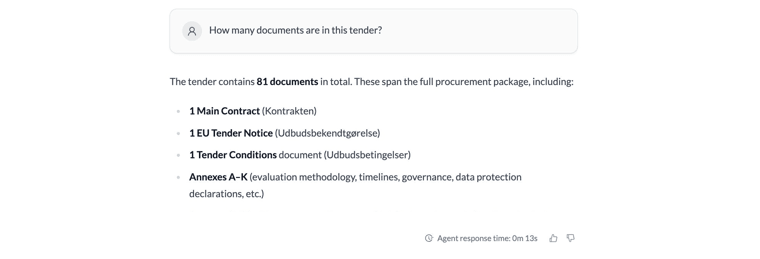
You just focus on your problem. Once Pentimenti has processed the tender, your only job is to think about the task at hand. Not how to prompt the AI. Not how to provide context. Not how to work around token limits or file size restrictions. You say: "Draft the methodology section emphasizing our Nordic delivery experience." Atlas handles the rest.
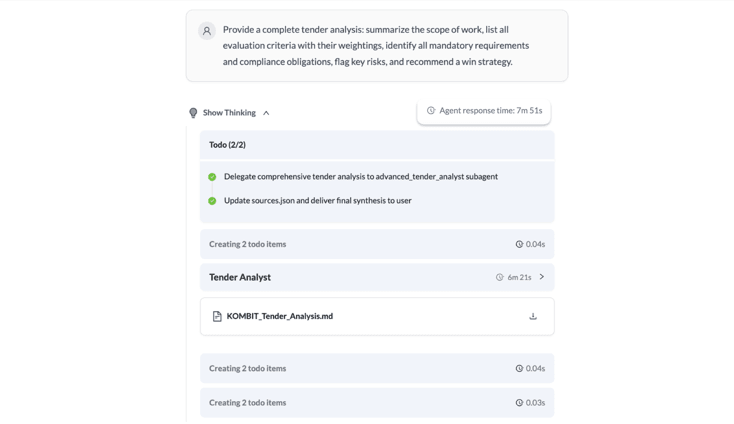
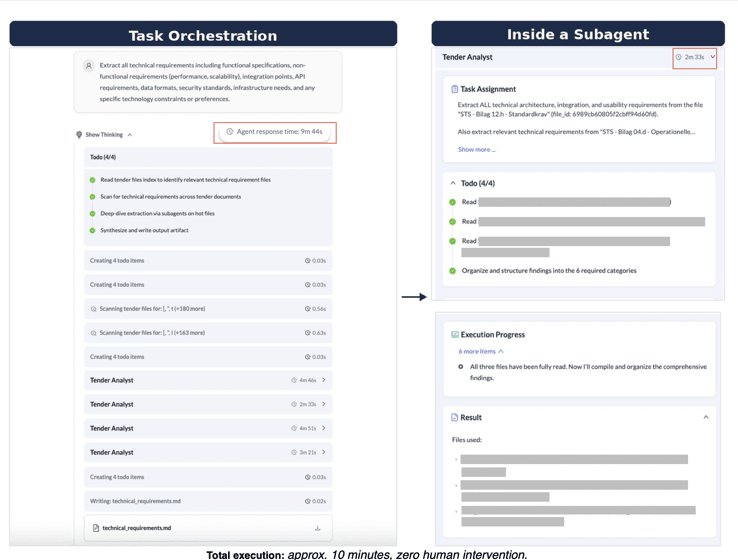
Atlas runs long, complex tasks on its own. This is where the agentic architecture truly separates itself. Atlas executes tasks that run for up to 30 minutes, reading across tens of documents simultaneously, iterating its own output, and delivering comprehensive results. It does not generate a paragraph and wait. You give it a task; it goes away, does the work, and comes back with a finished deliverable.
Pentimenti learns how you work. This is perhaps the most important architectural difference. When you teach Atlas a specific workflow, for example how your organisation structures executive summaries, how you approach pricing narratives, or how you handle compliance matrices, it remembers. The next time a similar task comes up, Atlas applies what it learned. Your institutional knowledge compounds inside the system instead of disappearing when someone leaves the team.
Why This Matters: The Due Diligence Perspective
For investors and technical evaluators, the architectural distinction between a retrieval tool, a generic LLM, and an agentic system is not academic. It determines the product's ceiling.
Foundation models are commoditized. The true defensibility of a platform like Pentimenti lies in the orchestration layer: the preprocessing algorithms that make a 500-file tender legible to an AI agent, the workflow learning system that encodes institutional knowledge, and the ReAct execution framework that enables autonomous multi-step task completion. Here is why that matters:
The context problem: Generic AI tools operate within a single session. Their understanding is bounded by a context window, and every interaction requires you to re-establish who you are, what the tender is, and what you need. Atlas pre-processes and retains the entire tender context persistently. The user never manages context. The system does.
The multi-document problem: Large Nordic public tenders routinely contain hundreds of files: technical specifications, legal frameworks, pricing templates, evaluation criteria, annexes, amendments. Generic AI starts to hallucinate and loses coherence beyond roughly 10 documents. This is not something that gets fixed with a larger context window. It is a fundamental limitation of stateless, session-based architectures. Pentimenti was engineered for document-heavy tenders. Our customers regularly process tenders with 500 to 1,000+ files without degradation.
The workflow problem: Every time you use a generic AI tool, you start from zero. There is no memory of how your organization structures responses, what tone you use, or which case studies work best for which sectors. Pentimenti accumulates organizational intelligence over time. It learns your workflows, your preferences, and your institutional patterns. The more you use it, the better it gets.
The autonomy gap: Retrieval tools and chatbots are reactive. They respond to prompts. An agentic system is proactive within the scope of its task. Atlas reasons about what needs to happen next, executes multi-step workflows, self-corrects, and delivers completed work, not fragments that require human assembly.
What Our Customers See
Pentimenti is not a prototype. It is the production system that enterprise customers use every day to win tenders across the Nordic market.
85% of proposal content is produced autonomously by Atlas. Human experts are involved at two touchpoints: strategic direction at the start and quality validation at the end. Everything in between is autonomous execution.
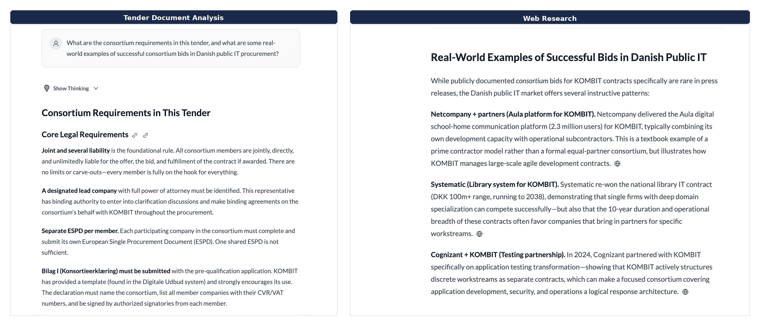
Time to first draft collapses from days to hours. The expert bottleneck, where subject matter experts get pulled into every section of every proposal, disappears. Our customers are saving hundreds of hours per project.
Scalability changes fundamentally. When the agent does the work, adding more proposals does not require adding more people. The constraint shifts from human capacity to compute capacity, and compute scales on a very different curve.
Built Six Months Ahead of the Market
When Jensen Huang described the agentic future of SaaS at GTC 2025, he was pointing to a direction the industry is moving toward. Most companies are now beginning to explore what agentic architecture means for their products.
We shipped it six months before that keynote.
Most proposal tools were designed around a content library because that was the best technology available at the time. Their data models, workflows, integrations, and interfaces all assume a human operator doing the core work. Retrofitting an agentic architecture onto that foundation is not a product update. It is a complete rebuild. And rebuilds take time that the market may not give them.
Pentimenti was not retrofitted. It was built natively for the agentic era.
See Pentimenti in Action
We are not asking you to take our word for any of this. We will load your most complex tender into Pentimenti, and you can watch Atlas work.
No prompting. No context management. No file limits. Just results.