OpenClaw vs. Enterprise AI: We Tested the Viral Agent So You Don't Have To
We put OpenClaw through controlled enterprise testing. Here's what happened when viral open-source AI meets real-world proposal workflows, and why the gap between hype and production-ready is wider than you think.
Niklas Klarnskou
CEO of Pentimenti · LinkedIn
OpenClaw vs. Enterprise AI: We Tested the Viral Agent So You Don't Have To
The Agent That Broke the Internet, and Why That Should Worry You
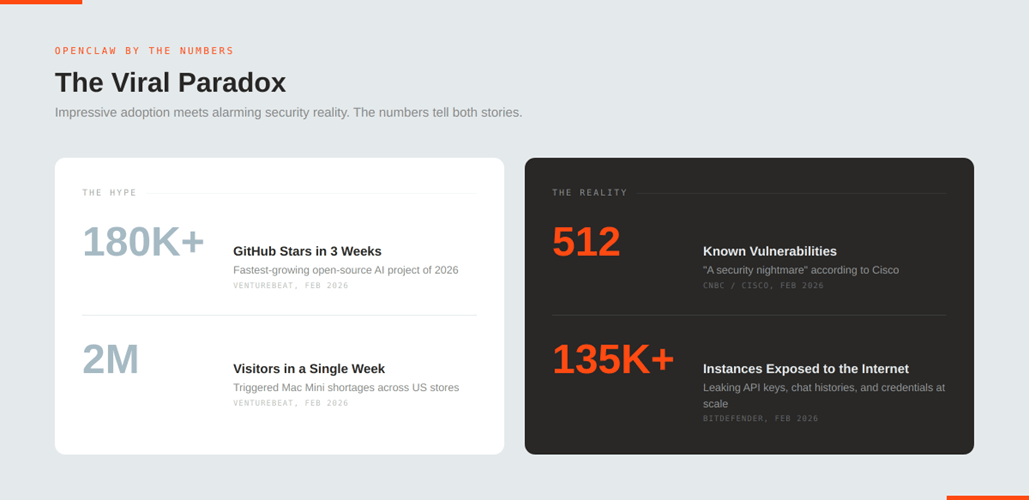
OpenClaw is everywhere. In three weeks, the open-source AI agent formerly known as Clawdbot has crossed 180,000 GitHub stars, attracted 2 million visitors in a single week, and triggered Mac Mini shortages across US stores. It promises something genuinely exciting: a persistent AI agent that follows you everywhere, manages your calendar, books flights, sends emails, and writes its own code for tasks it doesn't yet know how to do.
It also has 512 known vulnerabilities, 135,000+ instances exposed to the open internet, and has been called "a security nightmare" by Cisco, "a privacy disaster" by cybersecurity researchers, and "a dangerous preview of agentic AI" by Gartner.
At Pentimenti, we build agentic AI for enterprise proposal workflows every day. Our AI proposal and RFP response software uses ReAct (Reasoning + Acting) architecture to autonomously analyze RFPs, extract compliance requirements, and draft comprehensive responses, processing what used to take proposal teams two weeks in just three days.
So we decided to find out for ourselves: could OpenClaw handle real enterprise work? We put it through a controlled, sandboxed test using actual proposal workflows. Here's what we found.
What OpenClaw Gets Right (Credit Where It's Due)
Before the critique, let's be fair. OpenClaw demonstrates genuine capabilities that deserve recognition:
✅ Data cleaning and structuring: OpenClaw excels at processing and organizing messy data. Give it a CSV to clean or documents to sort, and it performs competently. Connect it to an API and it will do the same. For example, we had a long list of leads where we didn't have the correct domain. OpenClaw fixed that by connecting to the Brave Search API.
✅ Bookkeeping-style tasks: Repetitive, well-defined tasks with clear inputs and outputs (scheduling, logging, basic data entry), it handles reliably. Using a local browser to enter a system, it will reduce time spent on tedious tasks.
✅ A remarkable learning experience: For developers and technologists who want to understand how agentic AI works under the hood, OpenClaw is an incredible playground. The open-source community around it is impressive and rapidly iterating.
✅ Proof of concept for agentic AI: OpenClaw proves that community-driven, open-source agents can be genuinely powerful when given full system access. That matters for the future of AI development.
These aren't trivial achievements. OpenClaw represents a genuine step forward in accessible AI agent technology. But accessibility and enterprise-readiness are two very different things.
What Broke: Our Hands-On Test Results
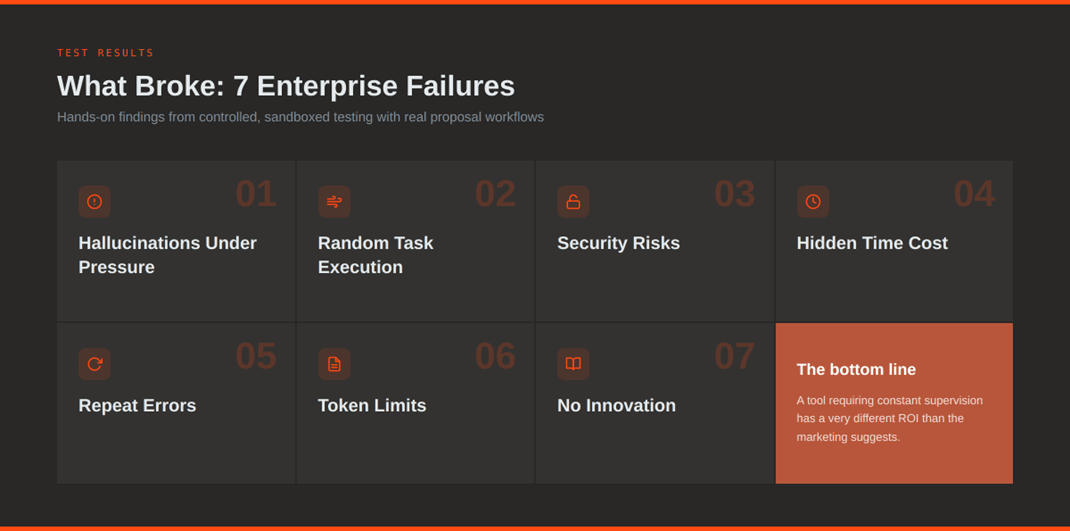
This is where the gap between viral technology and production-ready software becomes painfully clear.
1. Hallucinations Under Pressure
When tasks required domain-specific knowledge or contextual judgment, the kind of work that actually matters in enterprise settings, OpenClaw hallucinated. Not occasionally. Regularly.
It confidently generated incorrect statements and confirmed that scheduled tasks were working when they were not. In a proposal or compliance context, this isn't a quirk: it's a liability that could cost your organization a contract, a customer relationship, or worse.
Pentimenti's approach: Our Proposal Agent is built on a governed knowledge base architecture. When analyzing tender requirements, it draws from verified company data, past successful proposals, and structured compliance frameworks. The agent doesn't guess; it retrieves, validates, and cites its sources.
2. Random Task Execution
We observed OpenClaw executing tasks we didn't ask for, interpreting instructions loosely, and taking actions that deviated from the stated objective, essentially conflating different instructions.
In a hobbyist setting, this is a curiosity. In an enterprise workflow touching customer data or contractual commitments, random execution is unacceptable.
Pentimenti's approach: Our agents operate within bounded workflows. The Proposal Agent can analyze requirements, draft sections, and suggest improvements, but only within clearly defined guardrails. Every action is logged, auditable, and reversible.
3. Security Risks, Even in a Controlled Environment
We ran OpenClaw in a sandboxed, isolated environment. Even so, the architecture's defaults are alarming:
❌ Trusts localhost by default with no authentication
❌ External requests walk right in through reverse proxies
❌ Exposed instances are leaking API keys, chat histories, and credentials at scale
This isn't FUD: it's documented reality. Cisco, CrowdStrike, Kaspersky, and Palo Alto Networks have all published detailed security analyses confirming these vulnerabilities.
Pentimenti's approach: Enterprise-grade security isn't optional. We employ:
- ISO 27001 and SOC 2 compliance
- GDPR-compliant data handling (critical for EU AI Act readiness)
- Encryption in transit and at rest
- Role-based access controls with full audit trails
- Zero trust architecture with no open internet exposure by default
4. The Hidden Cost: Time Spent Managing the Agent
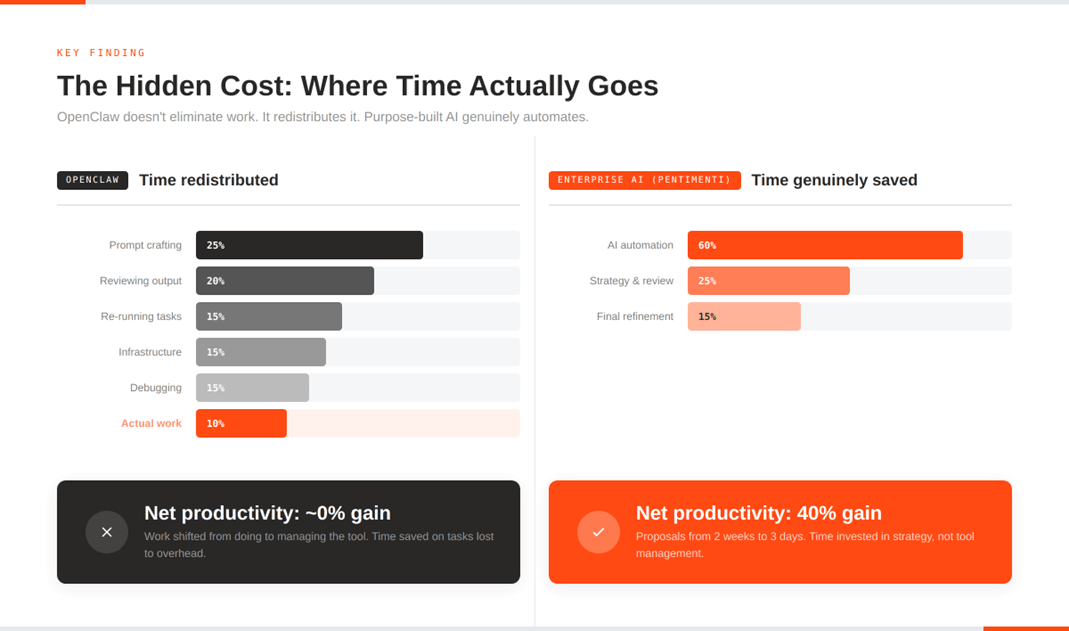
This was perhaps our most important finding. OpenClaw doesn't save you time; it shifts where you spend it.
Instead of doing the work, teams now spend significant time:
✏️ Crafting prompts specific enough to get useful output
🔍 Reviewing and correcting hallucinated content
🔄 Re-running tasks that failed or deviated
🛠️ Managing infrastructure and configuration
🐛 Debugging when the agent behaves unexpectedly
For teams that adopted AI to reduce manual effort, this is a step backward disguised as a step forward.
Pentimenti's approach: Our customers report 40% productivity gains and 4-month ROI because our agents are purpose-built for specific workflows. CS Wind reduced proposal timelines from 2 weeks to 3 days, not by shifting work, but by genuinely automating it.
5. Repeat Errors
Despite persistent memory being a headline feature, OpenClaw did not reliably learn from its errors within our test scenarios. The same prompt structure led to the same failures, requiring human intervention each time.
Pentimenti's approach: Our ReAct agents use iterative reasoning loops with self-critique mechanisms. When the Proposal Agent drafts a section, a separate Critic Agent reviews it for compliance, accuracy, and completeness, catching errors before they reach human reviewers.
6. Token Limits: Still Not Solved
Despite assurances that context window limitations have been addressed, we hit token limits that degraded output quality on longer, complex tasks.
For enterprise use cases that require processing lengthy RFP documents, compliance frameworks, or multi-section proposals, this is a structural constraint that no amount of prompt engineering can fully overcome.
Pentimenti's approach: We chunk and process documents intelligently, using semantic understanding to maintain context across sections. Our Compliance Metrics Engine can process 500+ requirements, filter to the 100 that matter most, and map them across proposal sections without losing critical details.
7. No Innovation: The Human Still Architects the Solution
This is the point that gets lost in the hype cycle.
OpenClaw can execute tasks, but it cannot design solutions. The strategic thinking, the structuring of a response, the understanding of what a client actually needs, the judgment about what to include and what to leave out. That remains entirely human work.
The agent is a tool, not a colleague. And a tool that requires constant supervision is a tool with a very different ROI than the marketing suggests.
Pentimenti's approach: We don't claim to replace human expertise. Our Proposal Agent augments your best proposal managers. It analyzes requirements in 15-20 minutes instead of days, generates stakeholder-specific summaries, identifies compliance gaps, and drafts sections, then hands it to your team for strategic refinement.
The Enterprise Reality: Why "Agent for Everything" Doesn't Work
The industry data backs up what our testing revealed:
-
Gartner's warning: Agentic productivity comes with unacceptable cybersecurity risk. OpenClaw is Exhibit A.
-
Forrester's prediction: Less than 15% of firms will turn on agentic features in their automation suites in 2026, and for good reason.
-
The 30/60 gap: 60% of enterprises expect AI agents to reach production, but only 30% actually do. The gap is governance, data quality, and the uncomfortable truth that most organizations aren't agent-ready.
-
Shadow AI risk: CrowdStrike found OpenClaw instances on corporate IP ranges, not just hobbyist machines. Employees are deploying this without IT approval. That's a compliance breach waiting to happen, especially under the EU AI Act, which takes effect in August 2026.
What Enterprise AI Actually Requires
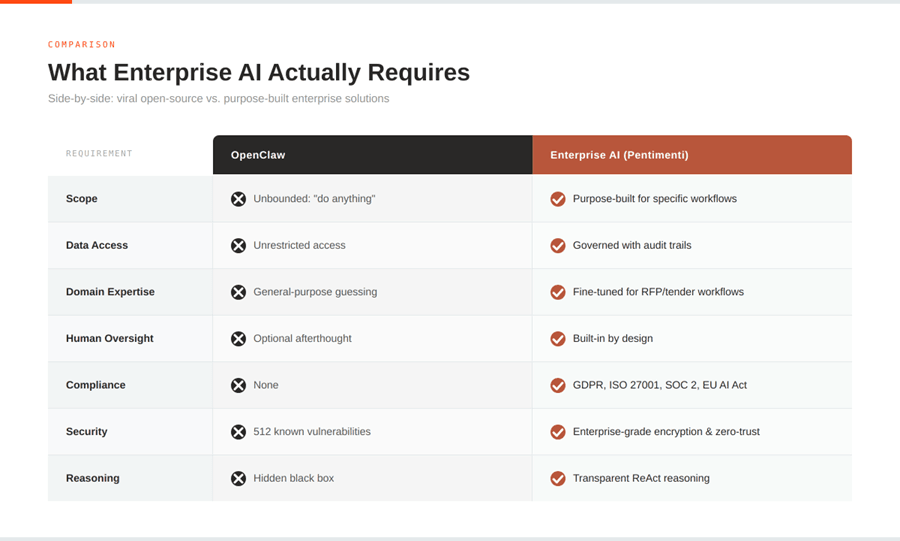
The most successful enterprise AI deployments in 2026 share common characteristics. At Pentimenti, we've learned this through building AI for enterprise proposal workflows: the value isn't in an agent that can do everything poorly. It's in an agent that does specific things exceptionally well, within guardrails that protect your data, your reputation, and your compliance posture.
The Right Question Isn't "Can AI Do This?" It's "Should This AI Do This?"
OpenClaw is a remarkable technical achievement. It deserves the attention it's getting. But the question enterprise leaders should be asking isn't whether an open-source agent can book flights, send emails, and write code autonomously.
The question is whether an uncontrolled, unaudited, ungoverned agent should be anywhere near your enterprise data, your customer information, or your contractual commitments.
The answer, based on our testing and mounting industry evidence, is clear: not yet, and probably not in this form.
The future of enterprise AI is agentic. But it's agentic within boundaries: purpose-built, governed, and designed for the specific workflows where AI delivers real value.
That's a less exciting pitch than "an AI that does everything." But it's the one that actually works.
Sources
- Cisco, Personal AI Agents like OpenClaw Are a Security Nightmare (Feb 2026)
- CrowdStrike, What Security Teams Need to Know About OpenClaw (Feb 2026)
- Kaspersky, New OpenClaw AI Agent Found Unsafe for Use (Feb 2026)
- Bitsight, OpenClaw Security: Risks of Exposed AI Agents (Feb 2026)
- Trend Micro, What OpenClaw Reveals About Agentic Assistants (Feb 2026)
- VentureBeat, OpenClaw Proves Agentic AI Works. It Also Proves Your Security Model Doesn't. (Feb 2026)
- Bitdefender, 135K OpenClaw AI Agents Exposed to Internet (Feb 2026)
- Fortune, Why OpenClaw Has Security Experts on Edge (Feb 2026)
- CNBC, From Clawdbot to Moltbot to OpenClaw: Meet the AI Agent Generating Buzz and Fear (Feb 2026)
- Forrester, Predictions 2026: Automation at the Crossroads (Nov 2025)
- Kore.ai, AI Agents in 2026: From Hype to Enterprise Reality (Jan 2026)