Beyond the AI Hype: A Guide for Executives Who've Been Burned
If you've already experienced AI disappointment, you weren't wrong to believe in AI's potential. The problem was timing, vendor selection, and AI-washing.
Niklas Klarnskou
CEO of Pentimenti · LinkedIn
Why Your Last AI Investment Failed (And How to Get It Right This Time)
For Senior Executives | 8-minute read
If you are a senior executive reading this in late 2025, there's a good chance you've already experienced AI disappointment firsthand. Maybe you invested in an "AI-powered" platform that turned out to be little more than glorified keyword search. Perhaps your team spent months implementing a solution that promised transformation but delivered incremental improvements at best. Or worse, you are still paying for software that sits unused because it created more work than it eliminated. You are not alone. And more importantly, you weren't wrong to believe in AI's potential. The problem wasn't your vision. The problem was timing, vendor selection, and the uncomfortable truth that most of what was sold as "AI" in 2023-2024 was marketing theater, not technological revolution. Let's talk about how to get it right this time.
The Three Uncomfortable Truths About Your Failed AI Investment
Truth #1: You Were Sold "AI-Washing," Not Real AI
The term "AI-powered" became meaningless in 2023. Vendors raced to slap AI labels on decade-old software, hoping you wouldn't look under the hood. Here's what probably happened:
- What they promised: Revolutionary AI that thinks, reasons, and solves problems autonomously
- What you got: A ChatGPT wrapper bolted onto legacy code, basically fancy autocomplete with a search function
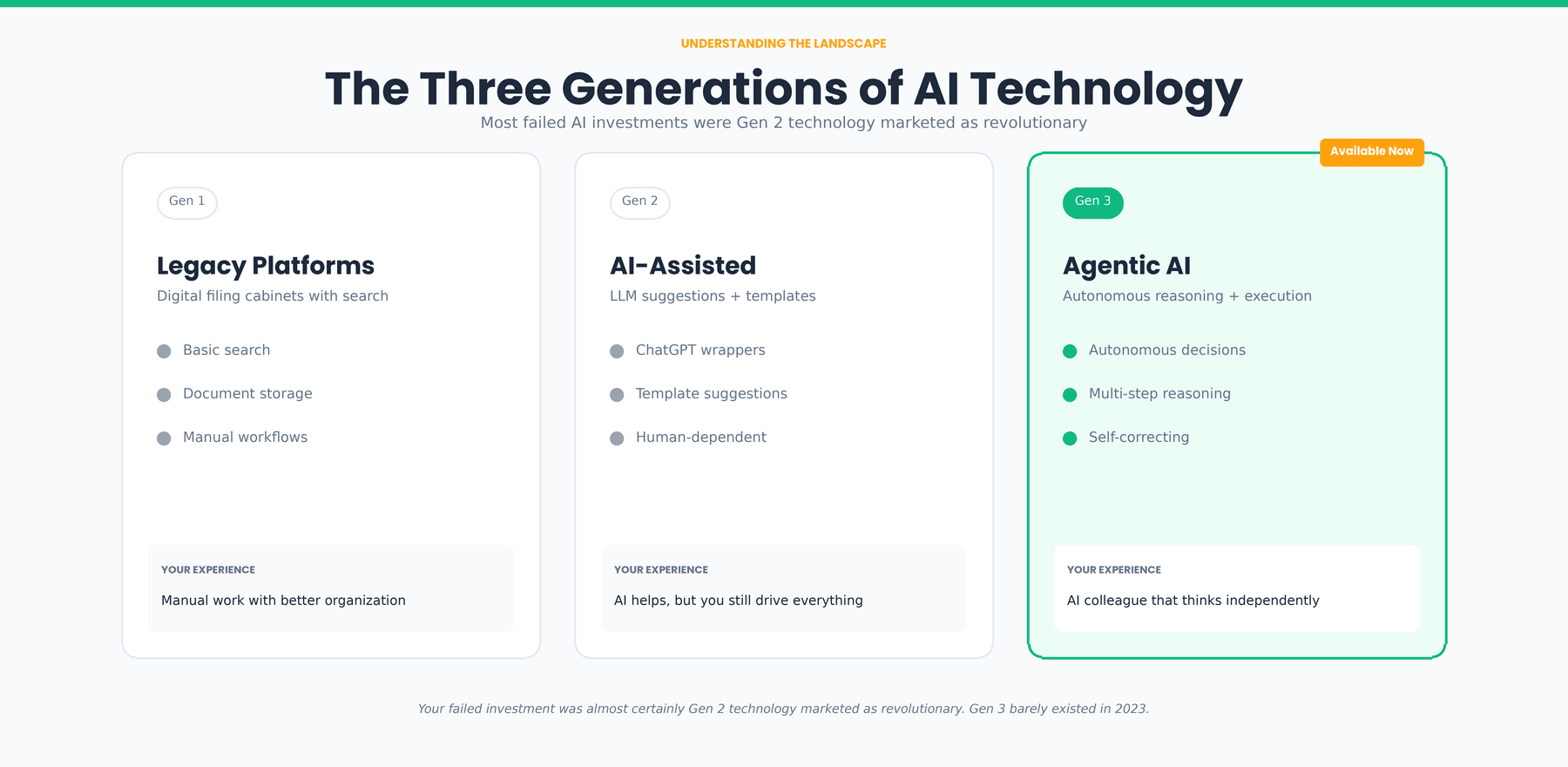
The technical reality? Most "AI solutions" you encountered were Generation 2 technology at best, AI-assisted tools that still required humans to do the thinking, decision-making, and quality control.
| AI Generation | What It Actually Does | What You Experience |
|---|---|---|
| Gen 1: Legacy Platforms | Digital filing cabinets with search | Manual work with better organization |
| Gen 2: AI-Assisted | LLM suggestions + templates | AI helps, but you still drive everything |
| Gen 3: Agentic AI | Autonomous reasoning + execution | AI colleague that thinks and acts independently |
Your failed investment was almost certainly Gen 2 technology marketed as revolutionary. Gen 3 barely existed in 2023.
Truth #2: They Retrofitted AI Onto a 10-Year-Old Architecture
Here's the architectural reality nobody told you: When established vendors added "AI features" in 2023-2024, they were bolting electric motors onto horse carriages, trying to modernize fundamentally outdated systems.
Why this matters to you as an executive:
- Technical debt accumulates: Every "AI feature" added to legacy code increases system complexity and fragility
- Performance limitations: Old architectures weren't designed for the computational demands of real AI
- Integration nightmares: Your team spent months (and consulting fees) trying to make it work with existing systems
- Slow innovation cycles: Established vendors need 18-month release cycles because they are maintaining decade-old code
The result? You paid premium prices for beta-quality features that never quite worked as promised. Above was, by the way, one of the reasons why we founded Pentimenti.
Truth #3: You Needed a Partner Who Understood Your Business, Not Just AI
The biggest gap wasn't technical, it was contextual understanding. Most AI vendors in 2023 were:
- AI labs trying to commercialize research papers
- Enterprise software companies adding AI as a checkbox feature
- Consultancies repackaging existing tools with AI branding
What was missing? Deep domain expertise in your specific business processes.
Generic AI can write decent marketing copy. It cannot understand the nuances of your procurement workflows, compliance requirements, stakeholder dynamics, and competitive positioning, unless it was purpose-built for your domain from day one.
What "Getting It Right" Actually Looks Like
Let's make this concrete with a real example from the tender management space (where Pentimenti's AI bid management platform operates).
The Old Way (What Burned You)
Scenario: Your company responds to 50+ tenders annually. Each requires 2-3 weeks of intensive work from multiple departments.
What the Gen 2 "AI Solution" Promised:
- AI will auto-fill responses from your knowledge base
- Cut time by 80%
- Easy implementation
What Actually Happened:
- ✗ AI suggested generic responses that needed complete rewriting
- ✗ Compliance team still manually checked every requirement
- ✗ 6-month implementation with consultants
- ✗ Actual time savings: ~15% (mostly from better document organization)
- ✗ Team adoption: 40% because it added steps instead of reducing them
Total ROI: Negative in year one. Marginal improvement by year two. Project quietly shelved.
The Gen 3 Approach (What's Actually Possible Now)
Same Scenario: 50+ tenders annually.
What Purpose-Built Gen 3 Agentic AI Delivers:
Week 1-2: Implementation
- Platform ingests your historical proposals, compliance docs, and knowledge base
- No restructuring of your existing content needed
- Team training: 2-4 hours total
Week 3: First Tender
- Upload tender documents (15 minutes to process)
- Stakeholder summaries auto-generated: Bid manager sees strategic overview, technical team sees requirements, finance sees budget implications (replaces 2-3 days of manual work)
- Compliance engine: 500 requirements filtered to the 100 that actually matter, automatically risk-scored
- Proposal Agent: Autonomously drafts sections while conducting web research to strengthen responses, handles tasks ranging from 30-second quick answers to 30-minute deep strategic analysis
Timeline: What took 2-3 weeks now takes 3-5 days Quality: Improved by 15% (measured by win rate) Team Experience: "Like having a brilliant analyst who never sleeps" Documented Results:
- Enterprise customer: 2 weeks → 3 days per proposal
- Actual 40% reduction in resource requirements
- 4-month ROI
The "Why Now?" Question You are Probably Asking
"Why should I trust AI in 2025 when it failed me in 2024?"
Fair question. Here's the honest answer:
What Changed Between 2023 and 2025
2023-2024:
- ChatGPT hype cycle
- Every vendor rushing to add "AI features"
- Retrofitting AI onto old platforms
- Generic models trying to do everything
2025:
- Agentic AI architecture (ReAct framework and autonomous tool calling)
- Purpose-built platforms designed for AI from day one
- Domain-specific models trained for specific business processes
- Transparent reasoning you can audit
The Risk Mitigation Framework for Skeptical Executives
If you've been burned before, here's how to approach AI investment with appropriate skepticism:
Phase 1: Proof-of-Concept (30 Days)
- Investment: Minimal financial commitment
- Test: Use your most complex, time-consuming process
- Success criteria: Clear before-and-after metrics
- Question to ask: "Show me the reasoning process, not just the output"
Phase 2: Pilot Implementation (60 Days)
- Investment: Limited team, limited scope
- Test: Real business scenarios with real stakes
- Success criteria: Team adoption rate + measurable time savings
- Question to ask: "What's working and what's not? Show me the data."
Phase 3: Scale Decision (90 Days)
- Investment: Full platform rollout
- Test: ROI calculation based on pilot data
- Success criteria: Positive ROI within 4-6 months
- Question to ask: "What does year 2 look like?"
De-Risking Through Architecture
Choose vendors who:
- ✓ Offer transparent pricing (no hidden consulting fees)
- ✓ Show you exactly how their AI thinks (reasoning transparency)
- ✓ Have specific domain expertise (not generic AI tools)
- ✓ Provide enterprise security certifications (GDPR, ISO27001, SOC2)
- ✓ Move fast (startup speed, not 18-month release cycles)
The Uncomfortable Advantage of Being "Late" to AI
Here's the counterintuitive truth: You are not behind. You are actually in a better position than early adopters.
Why?
1. You Learned What Doesn't Work
- Early adopters paid for vendor education (expensive lessons)
- You now know which questions to ask and which red flags to watch for
2. Real AI Finally Exists
- Gen 3 agentic architecture is now commercially available
- Purpose-built platforms exist (they didn't in 2023)
3. You Have Clear ROI Requirements
- No tolerance for vague promises
- Demand concrete metrics and proof points
- This discipline protects you from hype
4. You Can Learn from Others' Implementations
- Case studies and reference customers now exist
- See documented results before committing
What to do starting next week
For the Skeptical but Curious Executive: Immediate Actions (This Week):
- Audit your current "AI" investments
- Are you actually using them?
- What's the real ROI (be brutally honest)?
- What would "good" look like?
- Create your AI evaluation framework
- Use the question tables from this article
- Define clear success metrics (not vendor-provided)
- Establish 30/60/90-day checkpoints
- Identify your most painful, time-consuming process
- Where is your team spending 20+ hours that should take 2?
- What's costing you opportunities because it's too slow?
- This becomes your PoC test case
Next 30 Days:
- Talk to 3 vendors (including 1 purpose-built startup)
- Run them through your evaluation framework
- Ask for reasoning transparency (watch them squirm or confidently demo)
- Request reference customers who've been live for 6+ months
- Run a controlled PoC
- Same task, old way vs. new way
- Measure time, quality, team experience
- Trust data over promises
- Make a decision based on evidence
- If it works: Scale deliberately
- If it doesn't: Walk away with lessons learned
The Bottom Line for Executives
You weren't wrong about AI's potential.
You were sold incomplete technology at the wrong time by vendors who prioritized speed-to-market over actual capability. But here's what's changed in 2025:
- Gen 3 agentic AI exists (autonomous reasoning, not just assistance)
- Purpose-built platforms exist (not retrofitted legacy code)
- Proven implementations exist (documented ROI, not case studies from 3 years ago)
- Transparent reasoning exists (you can audit how AI makes decisions)
The question isn't "Should I trust AI again?"
The question is: "Do I have a framework to separate real AI from AI-washing?"
This article gave you that framework.
What you do with it is up to you.
But consider this: Your competitors are asking the same questions. The ones who get it right in 2025 will have an 18-month advantage before this becomes commoditized.
The window for strategic advantage is open.
How long it stays open depends on how quickly others figure out what you now know.
About Pentimenti
Pentimenti is a Gen 3 agentic AI platform purpose-built for tender and proposal management. Unlike legacy platforms retrofitting AI features, we were architected from day one (2023) for autonomous AI workloads.
Our differentiator: We show you our AI's reasoning process, not just outputs. Because if a vendor can't explain how their AI thinks, it's not thinking, it's searching.
Want to see the difference? [Book a 30-minute demo where we show you our agent's reasoning in real-time] or [Download our "Real AI vs. AI-Washing" executive checklist]
Key Takeaways:
✓ Most 2023-2024 AI investments failed because they were Gen 2 (AI-assisted) sold as revolutionary
✓ Ask vendors to show reasoning processes, not just outputs, this exposes AI-washing immediately
✓ Purpose-built beats retrofitted: Architecture matters more than brand recognition
✓ Use phased PoC approach to de-risk: 30/60/90-day checkpoints with clear metrics
✓ Being "late" to AI is actually an advantage, you learned from others' expensive mistakes